
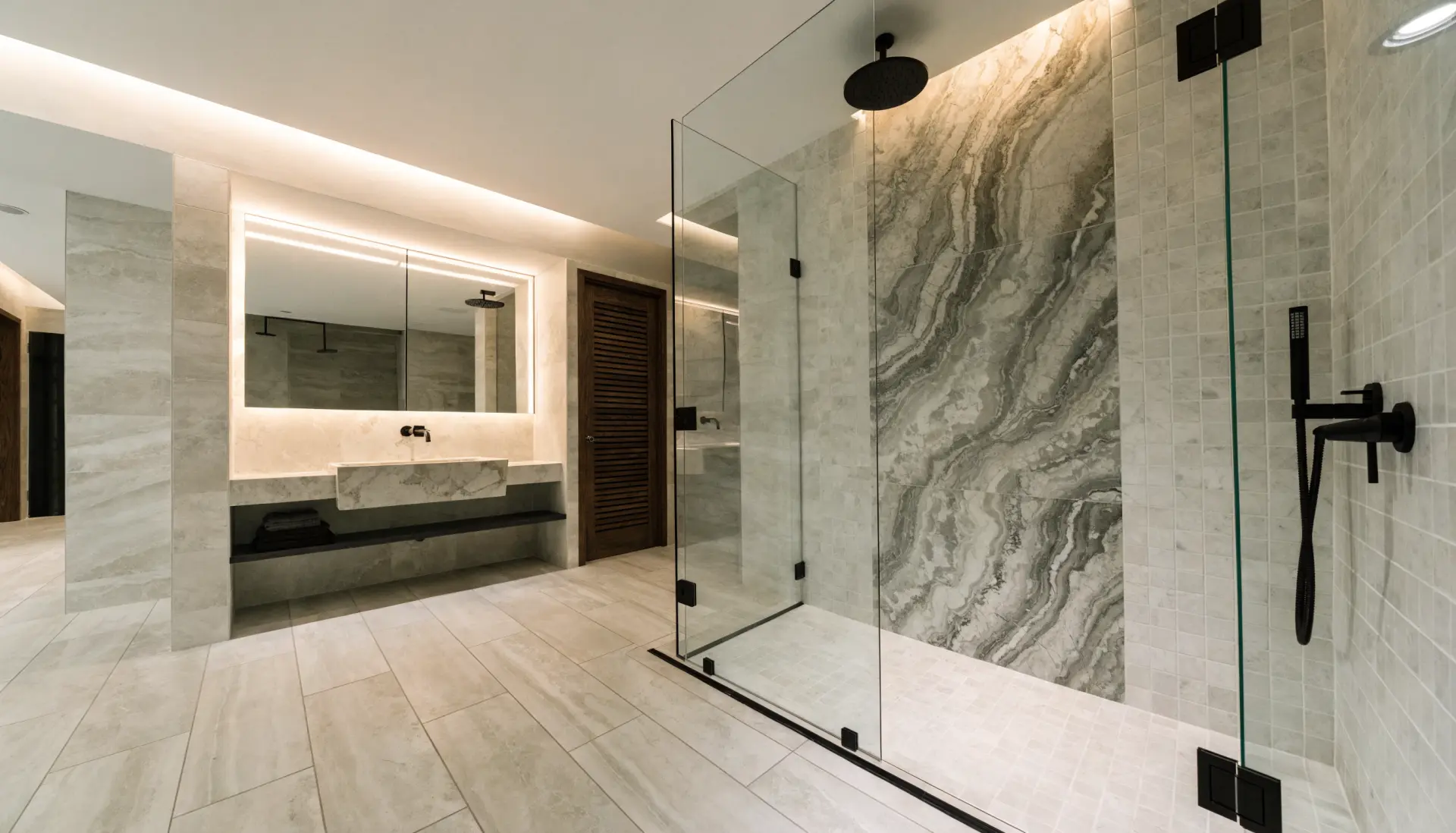
Bathroom Tile Installation
Bathroom tile installation set flat, level, and built to last — selection, substrate, setting, and grout, for floor and wall alike, as part of a full bathroom remodel by a licensed Florida general contractor. Free quote, no trip fee, same-day appointment scheduling.
Finished tiled bathroom Tile set on a wall
 Cement backer substrate
 Large-format floor tile
 Grout & even edges
 Slip-rated porcelain floor
 Tiled shower wall
 Herringbone / pattern detail
Bathroom tile installation as part of a full bathroom remodel
Gaven sets the tile as one phase of a full bathroom remodel — not as a job you can book on its own. Tile is the finished surface, and it depends on everything underneath being right first: the substrate flat and solid, the waterproofing done where it's needed, the layout planned around the fixtures. It goes in at a specific point in the remodel, on a surface that was prepared for it.
Gaven does notinstall tile as a standalone job, and is not a tile-only crew or a retailer's install service. If you want a single room tiled with nothing else happening, or you bought tile and want it set over an existing surface, a dedicated tile contractor or the retailer's installer is a better fit — Gaven isn't the right contractor for standalone tiling.
For a full bathroom remodel that includes tile, request a free quote and same-day appointment scheduling.
What bathroom tile installation involves in a remodel
Is tiling just sticking tile to the wall? The finished surface looks simple, and that's the trap. A tile job that stays flat, doesn't crack, and doesn't show uneven edges depends on a chain of decisions made before a single tile goes up — and most tile failures trace back to one of them being skipped.
In a remodel the tile goes in near the end, but it's planned from the start. The substrate has to be the right material and flat enough for the tile chosen. The layout has to be set so the pattern lands cleanly at the edges and the fixtures. The right mortar and grout have to be matched to the tile and the location — a shower floor and a powder-room wall are not the same job. Then the tile is set, leveled, and grouted.
What separates a remodel-grade tile job from a quick one is that it's done in sequence with the rest of the bathroom. The shower walls get tiled over the waterproofing that the walk-in shower installation phase puts in — the tile is the surface, the waterproofing underneath is its own separate step. The floor tile is coordinated with the vanity and fixtures so the cuts and transitions land right. Tile is the layer everyone sees, which is exactly why the layers under it have to be correct.
Tile being set on a bathroom wall during a remodelThe substrate: what tile actually goes on
The most common tiling question is also the most important: what goes under the tile? The answer is almost never plain drywall. Tile in a bathroom goes on a substrate built to handle moisture and to stay flat — usually cement backer board, or drywall only in dry areas well away from water.
The substrate does two jobs. First, it gives the tile something stable and moisture-tolerant to bond to; regular drywall in a wet area breaks down and takes the tile with it. Second, it has to be flat, because tile telegraphs whatever is under it. A substrate that dips or bows shows up as lippage — tiles whose edges sit at different heights — no matter how carefully the tile is set.
It's worth being clear about the line between substrate and waterproofing, because people blur them. The substrate is what the tile bonds to. The waterproofing — the continuous membrane that keeps water out of the wall — is a separate layer handled during the shower build. Tile sits on top of both. Gaven preps the substrate flat and sound before tiling, which is part of why the tile scope is priced inside the full bathroom tier pricing breakdown on the main bathroom remodel page.
Cement backer board substrate prepared for tileLarge-format tile and the flatness it demands
Large-format tile — the big slabs and long planks that have become the modern look — is where substrate flatness stops being a nicety and becomes a hard requirement. The bigger the tile, the less it can bridge an uneven surface, and the more any dip shows as lippage.
The standard is specific. According to the Ceramic Tile Education Foundation, for tile with at least one edge 15 inches or longer, the substrate can vary no more than 1/8 inch in 10 feet and no more than 1/16 inch in 2 feet from a flat plane. That's a tight tolerance — tighter than most floors come out of construction — which is why large-format tile so often needs the substrate leveled before setting. Skip that, and the big tiles rock, the edges lip, and the lippage catches light across the whole floor.
Large-format also changes the layout. Big rectangular tiles can't be run in a 50-percent brick offset the way subway tile can — staggering them that far causes them to bow and lip, so the offset is kept well under half. These are the specifics that separate a tile setter who knows large-format from one who learned on small tile. Gaven matches the substrate prep and the layout to the tile being installed, because a large-format floor set like a small-tile floor fails in the same predictable way every time.
Large-format tile set on a leveled bathroom floorGrout, lippage, and the details that show
Two finishing details decide whether a tile job looks professional up close: the grout choice and the lippage. Both are decided before and during setting, not fixed after.
Grout comes down to a performance decision. Cement grout is the traditional choice — it works well but it's porous, so it absorbs water and stains and needs to be sealed and resealed over time. Epoxy grout is non-porous: it resists water, stains, and chemicals, and it doesn't need sealing, which makes it a strong choice for a shower floor or a heavily used bathroom. It's harder to install and costs more, so it's matched to where it's worth it. Gaven picks the grout by location, not by habit.
Lippage — uneven tile edges — is the detail that separates clean work from amateur work, and there's an actual tolerance for it. For pressed porcelain tile with a standard grout joint, the allowable lippage is 1/32 inch. Beyond that, edges catch and the floor looks wavy. Hitting that tolerance is a function of substrate flatness, the right mortar coverage, and leveling clips during setting. On shower and wet installations the bar is even higher on the setting itself: the mortar has to make 95 percent contact behind the tile, versus 80 percent for a dry wall, because a hollow spot behind shower tile is where cracks and failures start.
Grout applied between tiles with even edgesFloor tile, slip resistance, and choosing for a wet room
A bathroom floor gets wet, and a wet tile floor that's too slick is a real hazard — so floor tile selection isn't just about looks. There's a measurable standard for it.
Slip resistance is measured as DCOF — dynamic coefficient of friction. For tile used on a floor that will be walked on wet, the DCOF should be 0.42 or greater under the ANSI A137.1 standard. A polished tile that looks beautiful in a showroom can fall below that on a wet bathroom floor, which is why the same tile that works on a wall isn't always right for the floor. Texture, finish, and rating all factor in.
This is also where material and location meet. Porcelain is the workhorse for bathroom floors — dense, low-absorption, and durable. Natural stone brings a look porcelain can't, but it's porous and needs sealing to survive a wet room, and it has to be chosen knowing that maintenance comes with it. Gaven selects floor tile for the wet environment it's going into — slip rating, absorption, and finish — not just for how it looks dry on a sample board. The selection is made during design, so the floor that goes in is the floor that lasts.
Slip-rated porcelain floor tile in a bathroomQuestions homeowners ask
Is bathroom tile installation available as a standalone project?
No. Gaven sets tile only as part of a full bathroom remodel that also includes demolition, plumbing, waterproofing, and final inspection. If you want a single room tiled with nothing else happening, or tile set over an existing surface, a dedicated tile contractor or the retailer's installer is a better fit — Gaven isn't the right contractor for standalone tiling.
What goes under bathroom tile?
Almost never plain drywall. Bathroom tile goes on a moisture-tolerant, flat substrate — usually cement backer board, with drywall only in dry areas away from water. The substrate has to be flat, because tile shows whatever is under it. It's a separate layer from the waterproofing membrane, which keeps water out of the wall; tile sits on top of both.
Do you charge to come measure and quote the tile?
No. The quote is free and there's no trip fee. The tile scope is measured and priced as part of the full bathroom remodel estimate, delivered at the site visit or within 24 hours.
Is large-format tile harder to install?
Yes, mainly because it demands a flatter substrate. For tile with an edge 15 inches or longer, the surface can vary no more than 1/8 inch over 10 feet — a tight tolerance that usually means leveling the substrate first. Large-format also can't be staggered like subway tile without bowing. It's a different skill set from small-tile work, which is why the prep matters as much as the setting.
Epoxy or cement grout — which is better?
It depends on location. Cement grout works well but is porous, so it absorbs water and stains and needs sealing over time. Epoxy grout is non-porous — it resists water and stains and needs no sealing — which makes it strong for shower floors and heavy-use bathrooms, though it costs more and is harder to set. Gaven matches the grout to where it's going rather than using one everywhere.
What tile is best for a bathroom floor?
For a wet floor, slip resistance matters as much as looks. Floor tile should have a DCOF slip rating of 0.42 or greater for wet walking surfaces. Porcelain is the durable workhorse; natural stone looks unmatched but is porous and needs sealing to survive a wet room. Gaven selects floor tile for the wet environment — rating, absorption, and finish — not just the showroom look.
Are you licensed to install bathroom tile in Miami-Dade?
Yes. Gaven Constructions holds Florida Certified General Contractor license CGC1524886, verifiable at MyFloridaLicense.com. The tile is set under that license as part of a permitted full bathroom remodel across Miami-Dade, Broward, and Palm Beach County.
Can you tile the shower as part of the remodel?
Yes. The shower walls and floor are tiled over the waterproofing that the walk-in shower phase installs — the tile is the finished surface, the waterproofing underneath is its own separate step. Shower tile is held to a higher setting standard, with 95 percent mortar contact behind it versus 80 percent on a dry wall, because a hollow spot behind shower tile is where failures begin.
Start a full bathroom remodel quote
Bathroom tile installation is part of the full bathroom remodel work Gaven handles across Miami-Dade, Broward, and Palm Beach County, as a licensed Florida general contractor. Free quote, no trip fee, same-day appointment scheduling.
Last updated August 2026.