
Smart Kitchen Appliances in Miami: Longevity Risks and What Actually Lasts
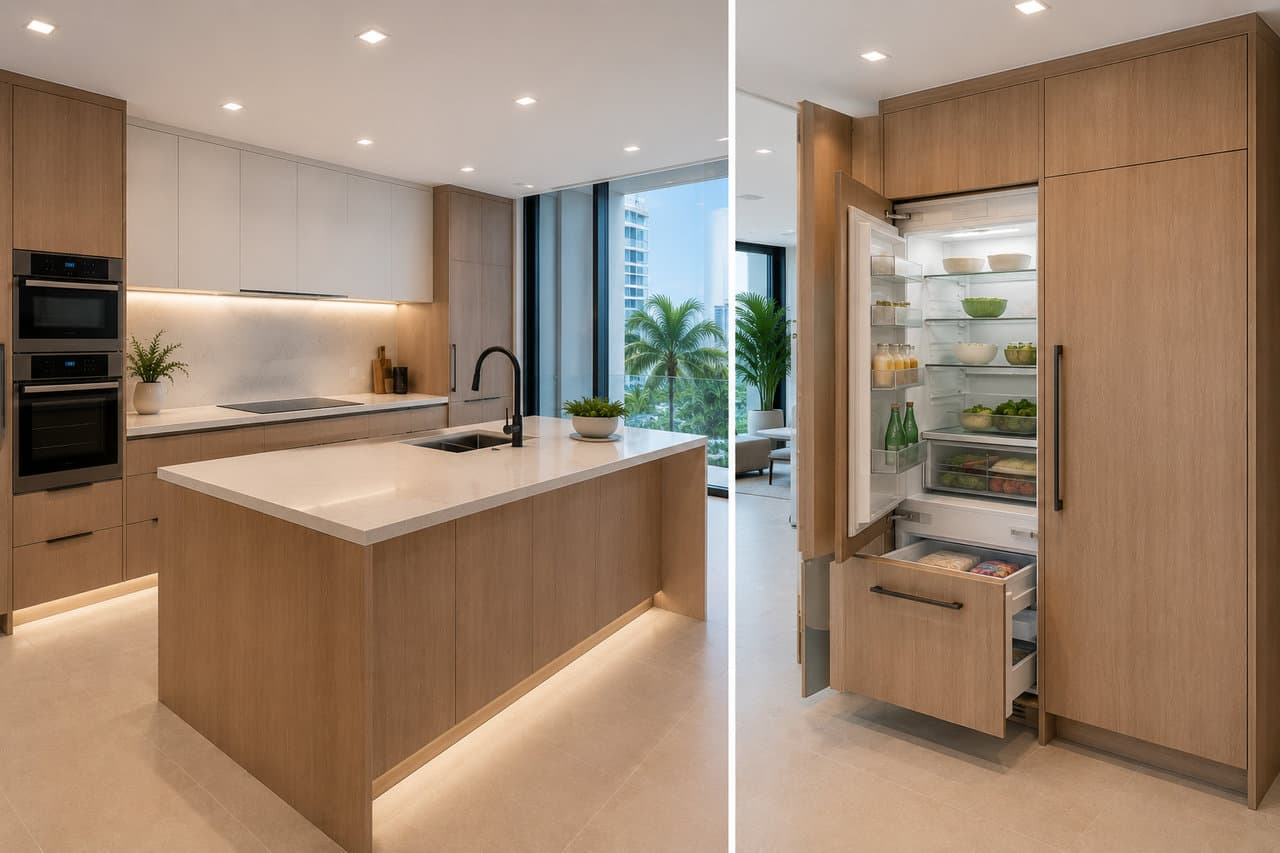
Smart kitchen appliances in Miami fail in ways the spec sheet never mentions. A Coral Gables homeowner spent $4,200 on a smart refrigerator in 2022. By 2025 the manufacturer had moved that model line off its current cloud platform. The fridge still cools. The app integration, the inventory cameras, the recipe features, and the touchscreen are limited or dead. The $4,200 spec is now a $1,400 dumb refrigerator with $2,800 of expired software. That pattern is not rare in coastal Miami homes — it is what happens when smart kitchen appliances meet a 10-year ownership window in a market with humidity, hurricane power events, and manufacturer cloud platforms that turn over every few years.
Smart kitchen appliances are worth it in Miami only when the appliance category actually benefits from connectivity and the manufacturer has a stable cloud platform. Three Miami-specific failure modes change the value math: coastal humidity at 60–85% indoor RH year-round stresses electronic control boards, hurricane-grade power events strand cloud-dependent features for multi-day periods, and manufacturer platform deprecation (Samsung SmartThings legacy drops, LG ThinQ migrations) can disable smart features within 3–7 years. Smart features genuinely earn the premium in ovens with internal cameras, induction ranges with precise temperature control, and refrigerators with diagnostics. They rarely earn the premium in dishwashers, ice makers, or coffee makers where the connected feature replaces a basic timer.
See where appliances fit in our Miami kitchen remodel scope and pricing →
National appliance reviews treat smart-fridge decisions as a uniform call. They are not. Coastal South Florida adds three operational variables that do not show up in national reviews.
The first is sustained indoor humidity. Coastal Miami-Dade and Broward homes run at 60–85% indoor relative humidity year-round even with HVAC operating; during construction phases that number spikes to 80–95%. Electronic control boards in smart appliances stress under sustained humidity in ways that non-connected appliances do not. The smart layer adds boards, sensors, touchscreens, and Wi-Fi modules — every one of which is a humidity-failure surface that a basic appliance does not carry.
The second is salt air. Standard reviews acknowledge that coastal hardware corrodes and recommend marine-grade hinges and pulls. They rarely discuss what happens inside the appliance. For homes within 5 miles of the Atlantic or Biscayne Bay, interior PCB corrosion accelerates measurably. Conformal coating on the boards is the manufacturer-side defense — specification-dependent, not universal. Most mainstream-tier smart appliances ship without it. The product spec sheet rarely says either way; you have to ask the dealer.
The third is the hurricane power event. Florida averages multi-day grid outages from major tropical systems. A smart refrigerator runs off a generator and keeps cooling — but the cloud features that justify the price premium go dark for the duration of the outage and stay degraded until grid restoration brings the manufacturer's regional servers back online.
Field observation — Coral Gables. We have replaced smart-appliance control boards 18–30 months after install in coastal high-rise condo kitchens at higher rates than in equivalent mainland Doral installations. Same brand, same model, same kitchen package. The coastal humidity exposure is the variable. The boards do not announce their failure — specific features stop working: the touchscreen loses sections, the camera disconnects, the temperature reporting goes stale.
A smart appliance is two products bolted together: a refrigerator (or oven, or range) that lasts 10–15 years mechanically, and a cloud-connected computer that depends on a manufacturer platform that may not last that long. When the manufacturer migrates platforms, drops support for older devices, or sunsets an app, the smart layer stops working. The mechanical appliance keeps going.Samsung SmartThings is the clearest case. Samsung announced in March 2021 that the original v1 SmartThings Hub — released in 2014 — would terminate June 30 of that year. The hub was 7 years old at termination. Customers got 3 months' notice. On December 31, 2022, Samsung shut down the SmartThings Groovy IDE — the development platform that custom device integrations relied on — and migrated to a new system called Edge, per the SmartThings Platform Transition FAQ. Devices that depended on community-developed handlers lost features.
LG ThinQ has gone through similar shifts. The original SmartThinQ app was replaced by ThinQ. LG TV Plus was folded in. ThinQ UP was integrated into a newer service called ThinQ PLAY. A new hub called ThinQ ON arrived in 2025. Older LG appliances continue to work — but the third-party integration layer that talks to them explicitly treats them as "legacy old models" with degraded polling intervals (status updates every 5 minutes instead of real-time), as documented in the Home Assistant LG ThinQ integration reference. GE SmartHQ went through a brand transition from earlier GE Connect platforms; the consumer app remains available but the underlying APIs are not contractually fixed.
Energy Star certifies appliance efficiency, which buyers can verify before purchasing. Energy Star does not certify software-support longevity. There is no equivalent program that says "this manufacturer will keep the cloud platform running for X years." The economic incentive runs the other way: appliances are sold once, but platforms cost money to run every month.
Process detail — how we spec appliances at Tier 02 and Tier 03 now. When we walk a homeowner through appliance selection for a Miami kitchen remodel at Tier 02 or Tier 03, the platform-stability conversation happens before the feature-set conversation. A homeowner staying 15 or 20 years cares more about which cloud platform survives the decade than which model has the slickest current app. Premium-tier manufacturers — Sub-Zero/Wolf, Thermador, Miele, Bosch — have historically taken a more conservative connectivity approach: fewer cloud-dependent features, more local-network operation, smaller surface area for platform deprecation to remove value. That conservatism is itself a longevity feature, which is part of why those brands keep showing up in 2026 Miami kitchen trends at the upper tier bands.
This section gets specific about the three operational failure modes. National reviewers cannot fake this content because they do not work in coastal South Florida.
Humidity and control boards. Indoor humidity 60–85% RH year-round is the baseline. Smart appliances carry more boards, more sensors, more connectivity hardware — bigger total surface area for humidity-driven failure than the basic version.
Salt air and PCB corrosion. Within 5 miles of the Atlantic or Biscayne Bay, salt air corrosion extends past visible hardware into the appliance's internal electronics. Conformal coating on PCBs is the manufacturer-side defense. Premium-tier integrated appliances are more likely to include it; mainstream-tier models often do not. Ask the dealer specifically: "Does this model have conformal-coated PCBs?" If the answer is "I'd have to check," that is itself an answer.
Hurricane-grade power events. Florida averages multi-day grid outages from major tropical systems. The appliance keeps working as a basic appliance while you have generator power. Smart features that depend on Wi-Fi plus the manufacturer's cloud platform are unavailable during the outage and stay degraded until grid restoration brings the regional cloud infrastructure back online. Plan for the smart layer to be effectively non-functional for 5–14 days per significant tropical event.
Lightning and control-board damage. Florida ranks at or near the top of U.S. lightning flash density. The 2025 AEM Lightning Report recorded Florida as the density leader at 76 flashes per square mile in 2024; the state slipped to second place behind Oklahoma in 2025 but remains first in U.S. lightning-related fatalities per the National Lightning Safety Council. For homeowners specifying smart appliances, the relevant number is the rate of transient over-voltage events that damage control boards. A nearby strike that does not hit your home can still send a voltage spike down the service line and degrade or destroy connected-appliance electronics.
Code interpretation — when surge protection actually gets scoped. We file every new or enlarged exterior opening under HVHZ compliance per Florida Building Code 8th Edition. Whole-house surge protection — a Type 1 or Type 2 device installed by a licensed Florida electrician with permit — runs $400–$1,000 in Miami-Dade/Broward. It sits on the main electrical panel and shunts surges to ground before they reach the kitchen. The kitchen scope does not automatically include this unless we raise it. For a kitchen running $40,000–$80,000 in appliances at Tier 03, a $400–$1,000 surge install is a proportional risk-management spec.
Talk through your kitchen appliance spec — call (786) 397-8380
The smart-appliance premium is the sticker difference plus connectivity infrastructure plus cabinet integration plus replacement-window risk if the cloud platform deprecates before the mechanical appliance does. Over a 10-year window the math looks different than the showroom presentation.
Sticker premium for a smart refrigerator vs. the equivalent non-connected model runs $1,200–$2,800 incremental in the mainstream tier (Samsung Family Hub or LG smart French-door vs. their non-connected siblings) — roughly 30–80% above the equivalent dumb model. On the premium tier (Sub-Zero, Thermador, Miele), connectivity is often a feature within an already-integrated platform.
Connectivity infrastructure is usually buried. Wi-Fi coverage in older Miami CBS construction often requires a mesh router upgrade to reach the kitchen — budget $200–$500 for a mesh node.
Cabinet integration is the bigger TCO line at the upper tiers. A paneled smart refrigerator drives custom panel, trim, and alignment decisions. At Tier 03 and Tier 04, paneled integration adds $1,500–$4,000+ in cabinetry beyond the appliance itself. The Miami kitchen cost guide carries the full tier-band breakdown — we won't repeat it here.
The December 31, 2025 Section 232 Presidential Proclamation on imported timber and derivative cabinet products adds a layer. Italian and European cabinetry — common at Tier 03 and Tier 04 where paneled smart appliances live — carries a 25% tariff through 2026 with a 50% step-up deferred to January 2027, translating to $1,500–$5,000+ on the cabinetry line. If the smart appliance drives the paneled cabinet spec, the tariff is part of the smart-appliance decision.
Replacement-window risk does not appear on any showroom comparison. If the cloud platform deprecates within the 10-year window, the smart features stop working and the smart premium evaporates while the mechanical appliance continues. Based on Samsung SmartThings v1, LG ThinQ migrations, and GE SmartHQ rebranding, plan for a 60–80% probability that the platform you buy in 2026 will not be the platform serving that appliance in 2036.
There are no recurring monthly subscription fees for basic smart features on current Samsung, LG, or GE residential appliances — apps and connectivity are included with purchase. That is also the structural reason platforms deprecate: manufacturers carry no recurring-revenue commitment to keep the platform running.
Integrated and panel-ready appliances only work if the cabinetry was built around them — panel thickness, hinge clearance, and filler dimensions get committed at the cabinet order, months before delivery.
Where smart features actually earn the premium in a Miami kitchen
The analysis above is skeptical. It is not absolutist. The honest answer is category-specific.
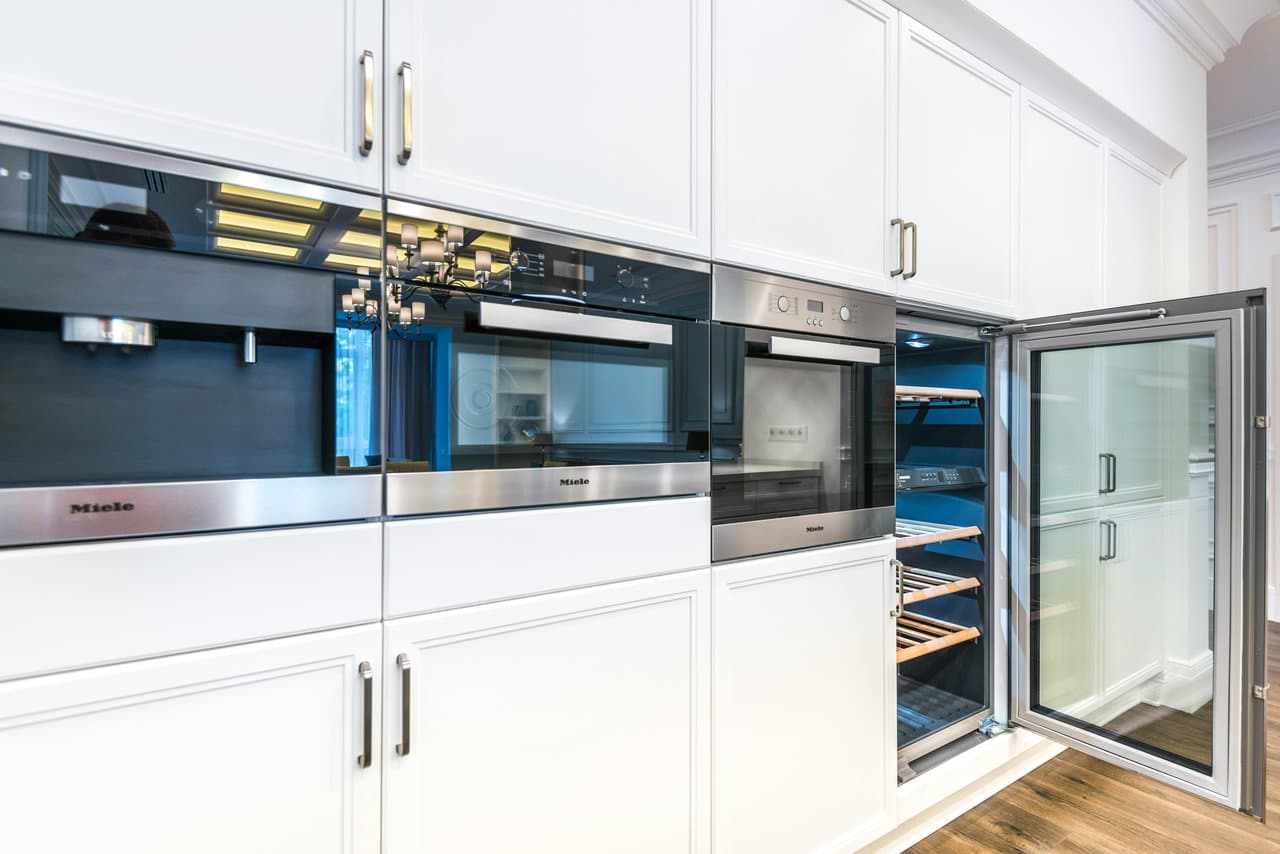
Smart ovens with internal cameras and AI cooking modes — high signal. The connected feature directly improves a frequent task: remote monitoring during preheating, internal camera to check on roasting without opening the door, automatic mode selection. Premium-tier: Bosch 800-series, Thermador Pro Grand, Sub-Zero/Wolf integrated wall ovens. Mainstream: GE Profile, Samsung Bespoke AI, LG ThinQ ovens.
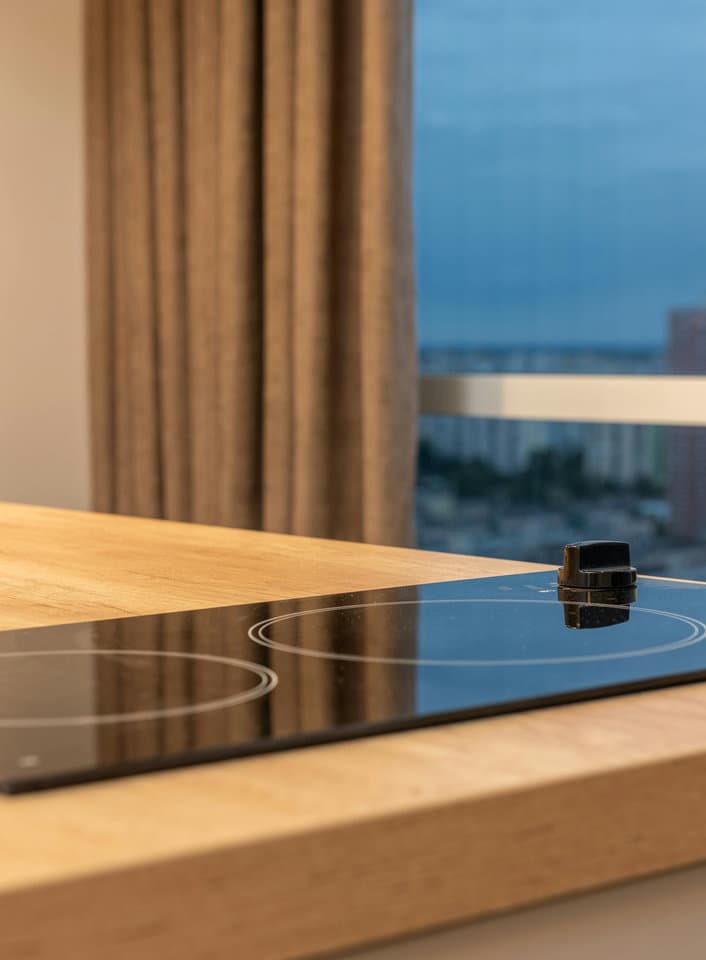
Smart induction ranges with precise temperature control — high signal. Same logic. Connectivity that improves a frequent cooking task. Bosch, Miele, and Thermador on the premium side; Samsung, LG, and GE on the mainstream side. Induction is already the Miami condo kitchen default for coastal high-rise applications — the smart-connectivity layer on top is incremental value where it gets used.
Smart refrigerators with diagnostic reporting — moderate signal. Diagnostic reporting (cooling efficiency, door-left-open alerts, water filter life) is genuinely useful. Internal cameras and touchscreen displays earn the premium less often than marketing suggests. Premium: Sub-Zero, Thermador, Miele. Mainstream: Samsung Family Hub, GE Profile, LG InstaView. Buy for the diagnostics, not the camera.
Smart dishwashers, ice makers, and coffee makers — low signal. The connected feature mostly replaces a basic timer. The 30–60% premium rarely earns back. The 2026 model-by-model lineup covers where each category sits on current lead times and pricing.
Smart faucets — niche signal. Moen Smart Kitchen Faucet, Delta Touch2O VoiceIQ, and similar voice-controlled fixtures have a real use case in food-prep cleanup. Decide based on actual cooking patterns.
The framework collapses into six decisions at appliance-selection time.
-
Pick categories where the smart feature improves a frequent task. Ovens, induction ranges, possibly refrigeration with diagnostics. Skip categories where smart equals timer-replacement.
-
Prefer manufacturers with conservative connectivity strategies. Premium-tier brands (Sub-Zero/Wolf, Thermador, Miele, Bosch) have historically built fewer cloud-dependent features and run them on more stable platforms. Mainstream-tier brands (GE, Samsung, LG) ship more features and refresh platforms more often. The conservative spec is also the longevity spec.
-
Spec whole-house surge protection during the remodel. A $400–$1,000 install on a kitchen running $40,000+ in appliances is the right proportion of risk-management spend. Schedule the licensed electrician during the kitchen rough-in phase.
-
For coastal homes within 5 miles of saltwater, ask the dealer about conformal-coated PCBs. Some premium-tier models have them; most mainstream models do not. The conversation forces the dealer to check, and the answer informs the spec.
-
Plan for the cloud platform to deprecate before the appliance's mechanical lifespan ends. The decision at year 7 should already be factored into the year-zero spec.
-
Be honest about which features you will actually use. A smart refrigerator camera that gets opened twice a month does not earn its premium. A smart oven used four times a week probably does.
Smart kitchen appliances are not a default yes and not a default no. They are a category-specific decision that has to account for the manufacturer's platform stability, the coastal environment's failure-mode profile, and the homeowner's actual usage pattern. In a Miami kitchen at Tier 02 or above, the honest answer is usually: smart in two or three high-value categories (ovens, ranges, possibly refrigeration diagnostics), non-connected in the rest.
Schedule a Miami kitchen remodel consultation — free quote, no trip fee
Gaven Constructions handles full kitchen remodels across Miami-Dade, Broward, and Palm Beach County. The consultation is free. The trip is free. The conversation is honest about which smart appliance specs earn their premium and which ones do not.
Last updated August 2026
Florida Certified General Contractor — CGC1524886