
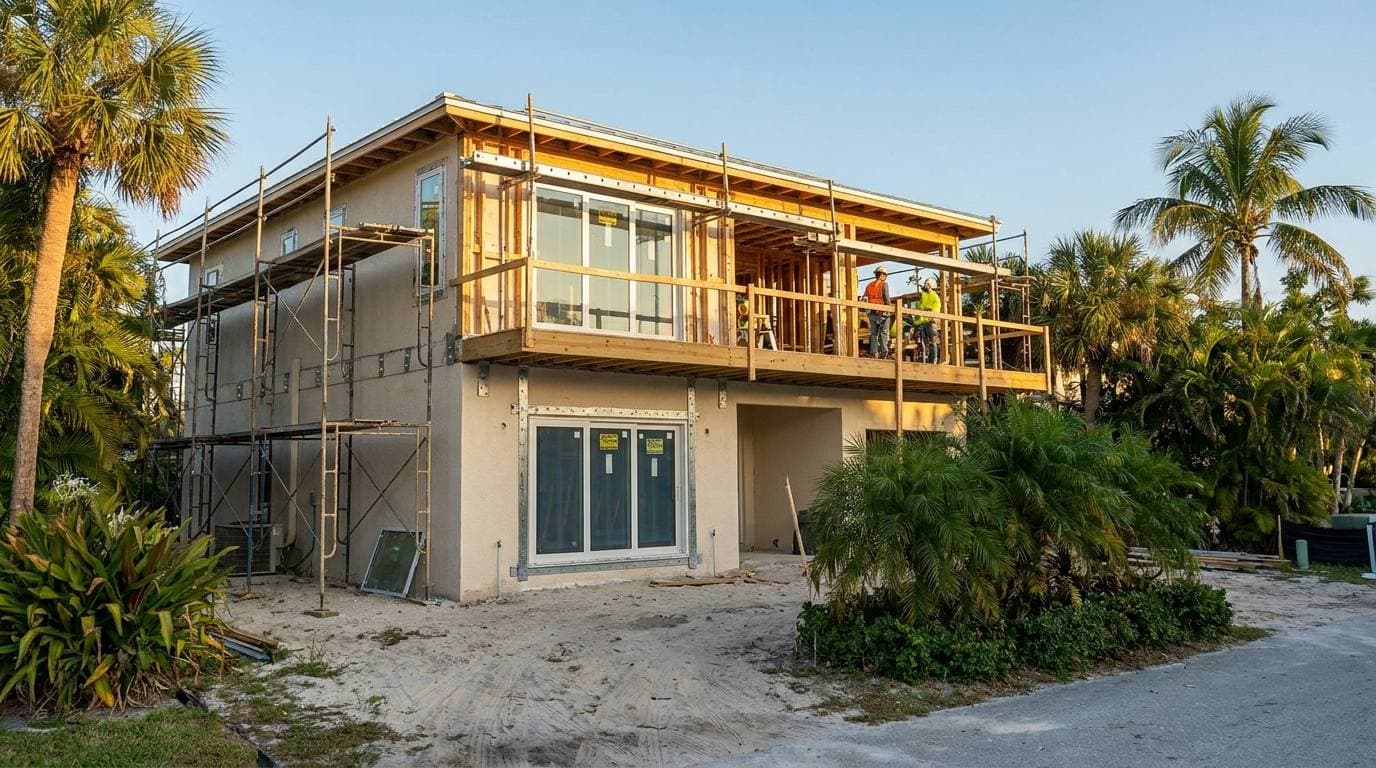
General Contractor near Deering Estate
General contractor near Deering Estate means working in a part of south Miami-Dade where houses still sit on septic, and where a county rule adopted in 2022 decides what may replace a system before the building permit is issued.
The question under the house, before the one inside it
Along this stretch of shoreline, plenty of houses treat their own wastewater on the lot. That is invisible until a project makes it visible, and then it stops being a plumbing detail and becomes a second approval, from a second agency, in a fixed order. It does not attach to most renovations. Whether it attaches to yours is decided by two facts: whether a public sewer is available to you, and whether your scope forces the existing system to be replaced entirely.
No sewer, and full replacement — it attaches
Sewer available, or no full replacement — it does not
The rule is county-wide. The score is local
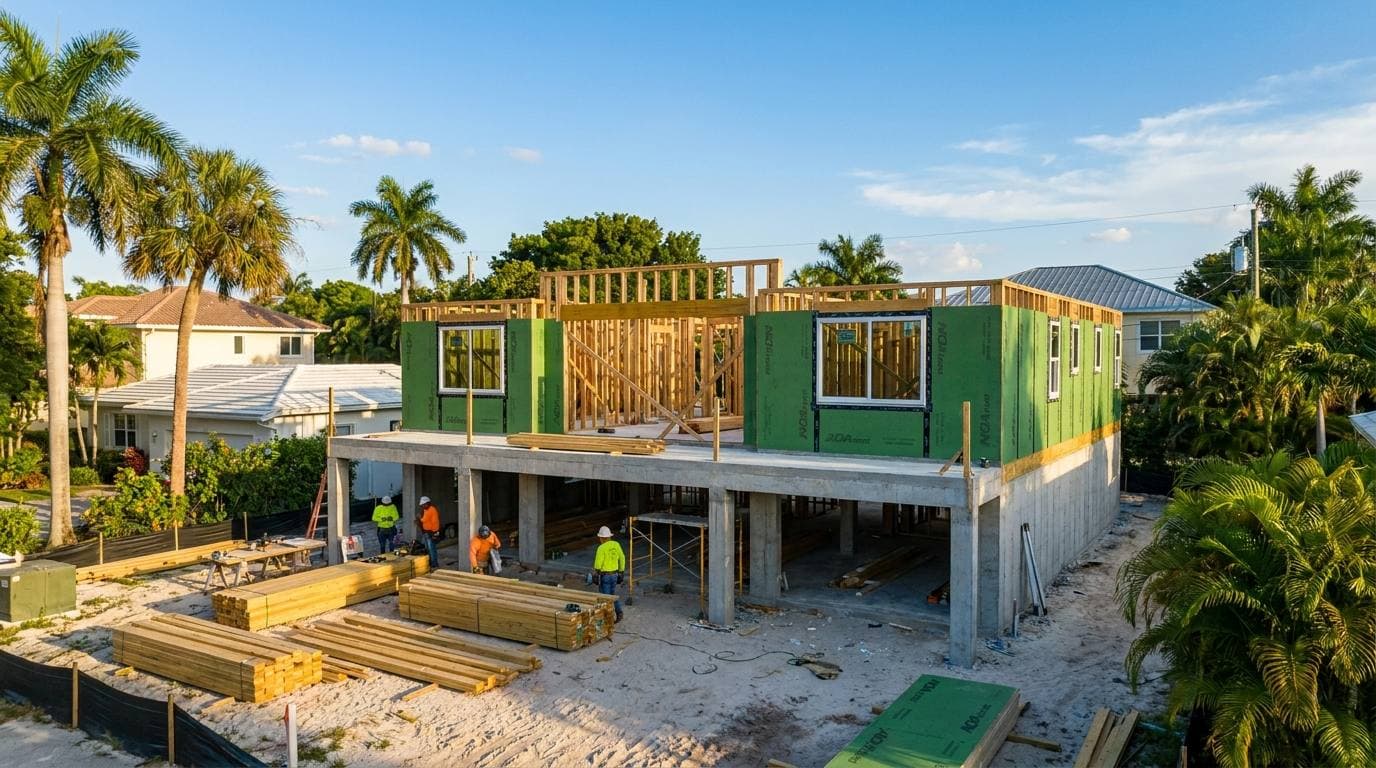
The Deering Estate is 444 acres on the edge of Biscayne Bay — a historic house museum and ecological preserve, listed on the National Register, owned by the State of Florida and run by Miami-Dade County Parks as one of seven county Heritage Parks. What makes it useful to a contractor is not its history. It is that the land around it is low, close to water, and still substantially served by onsite wastewater systems rather than by public sewer.
In July 2022 the county commission adopted an ordinance that created a new section of the county code and moved review of these systems to the environmental division, effective the following January. The headline is short: conventional septic systems are no longer allowed for new installations or for total replacements, anywhere in Miami-Dade, residential or commercial. What is permitted instead is a graded family of systems, defined by the quality of the effluent they produce before it reaches the drainfield.
Which grade a given property gets is not a choice. It is scored against a checklist, and most of the checklist is geography: whether the property is on public water, whether it sits completely outside a wellfield protection area, whether sewage flow and loading stay under their thresholds — and two separate questions about water, one asking whether the system is at least 100 feet from any surface water body, the other whether any surface water body lies within 1,000 feet of the closest property line. The county explains the arithmetic itself: for most projects any answer of no will trigger the next level of treatment, or in some cases will make the project not approvable.
That last clause is the one worth carrying into a first conversation. Not approvable is a real terminal box on the county's own decision chart, reached by a specific combination of separation and distance rather than by bad luck. Near a bay and the canals that feed it, those inputs are worth establishing early rather than discovering them in plan review.
Four numbers that decide the job
None of these needs a designer or a survey to start with. They need a lot size, a fixture count and somebody who knows which document clears which desk, in which order. Settled at the front of a project, they shape the budget. Settled in plan review, they reset the schedule.
Six phases, and one extra desk in the middle
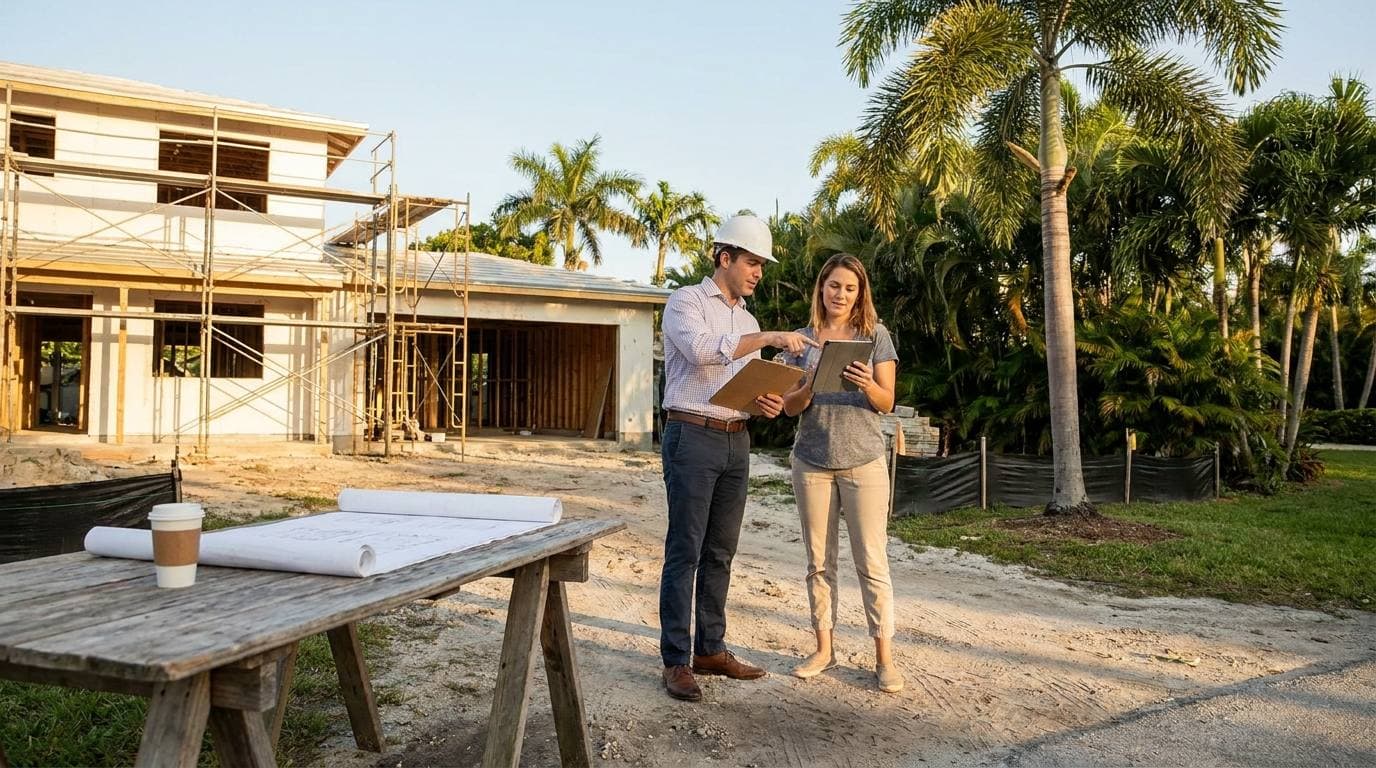
The sequence is the one we run everywhere. On a septic lot the front of the job acquires a question about wastewater rather than about finishes, and the permitting phase acquires a second reviewer who has to be approached in a particular order.
Discovery
We establish how the property is served, what the scope does to fixture count and bedroom count, and whether any of that forces a full replacement. Free site visit, and these answers come out of it.
Design and scope
Scope is locked against those answers. Where an engineer is needed for the onsite system, that engagement is named and priced here rather than folded into an allowance nobody can see the bottom of.
Permit and pre-mobilization
Order is not optional. Drawings go to the building department having jurisdiction first; only once it issues a process or permit number do the plans go to the county's environmental division for its own approval. Later revisions go back to it too.
Demolition and rough-in
Site protection first on a lot where the drainfield and its reserved area both have to survive the job — neither is a place to stage material or park a truck.
Finishes and millwork
The part everyone pictures, running on the schedule the earlier phases protected.
Final walkthrough and warranty
Closeout, documentation and handoff, including any operating paperwork a new system carries into the owner's hands.
From the Deering Estate to our office
The Deering Estate sits at 16701 SW 72nd Avenue, off Old Cutler Road on the bay side of Palmetto Bay. We are at the other end of the county, at 8200 NW 41st Street, Suite 200-4, Doral, FL 33166 — NW 41st Street is Doral Boulevard. The usual run is inland to South Dixie Highway, north to the Palmetto Expressway, and north again to the Doral exits.
It is a real drive and we have never charged for it. Call before you come, or let us come to you — the site visit is free, and on a septic property there is more to learn standing on the lot than sitting across a desk.
The license is the difference
The ordinance is not ours and neither is the rule that follows from it. The county publishes both: the July 2022 ordinance, the new code section it created, and the sentence retiring the conventional septic system for new work and full replacements. Miami-Dade County, Onsite Sewage Treatment & Disposal Systems
Every number on this page — the 25 percent addition rule, the 15,000 square foot minimum lot, the 100-foot setback, the 36-inch separation above the wet season high water table, one system per lot — comes from the county's own guidance manual for the engineers who design these systems, and you can read the same pages we did. Miami-Dade County, OSTDS Guidance Manual (PDF)
So is the decision chart. The county publishes the flow chart its own reviewers follow for a single-family residence or duplex, including the box marked project cannot be approved and the conditions that lead to it. Miami-Dade County, OSTDS type decision flow chart (PDF)
Work near the Deering Estate is contracted, executed and invoiced by Gaven Constructions under the license above. The onsite system design itself is sealed by a Florida professional engineer — the law, not a preference. Our job is to scope it, sequence it and price it before the project is approved.
The same license builds on sewer and on septic
One more agency in the sequence changes the order of the paperwork. It does not change the trade. Additions, whole-home remodels and new construction across Miami-Dade, Broward and Palm Beach run under the same Florida general contractor license and the same six phases. A septic lot is one set of conditions we are set up for, not a different company.
Building near the Deering Estate
I want to add a bedroom to a house on septic near the Deering Estate. Does that on its own mean a new system?
No, and the county's wording is precise about why. The work that requires review is the addition of bedrooms for single family residences that required complete replacement of the OSTDS — the replacement is the trigger, not the bedroom, and complete replacement means the septic tank and the drainfield both. The other side of that line is stated just as plainly: modifications and repairs that stop short of complete replacement need no review or approval. So the real question is never whether you are adding a bedroom. It is whether the system you have can carry what the finished house will produce.
How do I know whether I can keep an onsite system at all, or have to connect to the sewer instead?
Two tests, in order. First, nobody may install a new onsite system or replace an existing one in whole or in part if an approved public sewer is available and operative in a right-of-way abutting the property. If that is true the answer is connection, and the county's guidance says in capitals not to submit plans that include an onsite system. Second, if no sewer abuts, the county calculates a feasible distance from the nearest point of connection. One exception is worth knowing before you size an addition: only for additions under 25 percent of existing building area is that distance calculated on the addition alone.
Why can a failed septic tank not simply be replaced with the same thing?
Because that category of system no longer exists here for this purpose. In July 2022 the county adopted an ordinance creating a new section of the code and, with it, a rule stated without qualification: no new onsite system, and no replacement of an entire existing system, may be a conventional Type 1 system. What replaces it is a Type 2, 3 or 4 — graded by the quality of the effluent it produces before that effluent reaches the drainfield — and every design must be prepared by a Florida professional engineer.
What does being this close to Biscayne Bay actually change about the design?
It changes the score, and the score chooses the system. Two of the county's yes-or-no criteria are about water specifically: whether the system sits at least 100 feet from any surface water body, and whether any surface water body lies within 1,000 feet of the closest property line. The county's own guidance explains what a no does — for most projects any answer of no will trigger the next level of treatment, or in some cases will make the project not approvable. Along a shoreline and the canal corridors that reach it, those two questions do not answer themselves the way they do inland.
Are you licensed, and how do I check it myself?
Gaven Constructions is a Florida Certified General Contractor, license CGC1524886, and the work is contracted, executed and invoiced by that company. You can look the number up yourself on MyFloridaLicense before you sign anything, and the permit history is public record on BuildZoom: 500+ projects since 2015, 37+ BuildZoom-verified permits. On a septic property the licence matters for a specific reason — the onsite system design is sealed by a professional engineer, not by us, and knowing which document belongs to whom is half of keeping the schedule honest.
Do you charge more to work this far south than closer to your office?
No. One structure covers Miami-Dade, Broward and Palm Beach, with no distance surcharge and no minimum that moves with the address. Our office is in Doral, at the other end of the county, and it has never been a line on an estimate. What changes on a septic lot down here is sequence rather than rate — one more agency, in a fixed order — and whatever that sequence requires is identified and priced before a project is approved. We also do not take partial work: no single-trade jobs, no fixture swaps.
Two questions, and we can answer them on the phone
Is there a sewer available to the property, and does the work force the existing system to be replaced whole. Those two answers decide whether a second agency joins your permit. We can usually get most of the way from the address and a description of the scope.
Last updated September 2026.